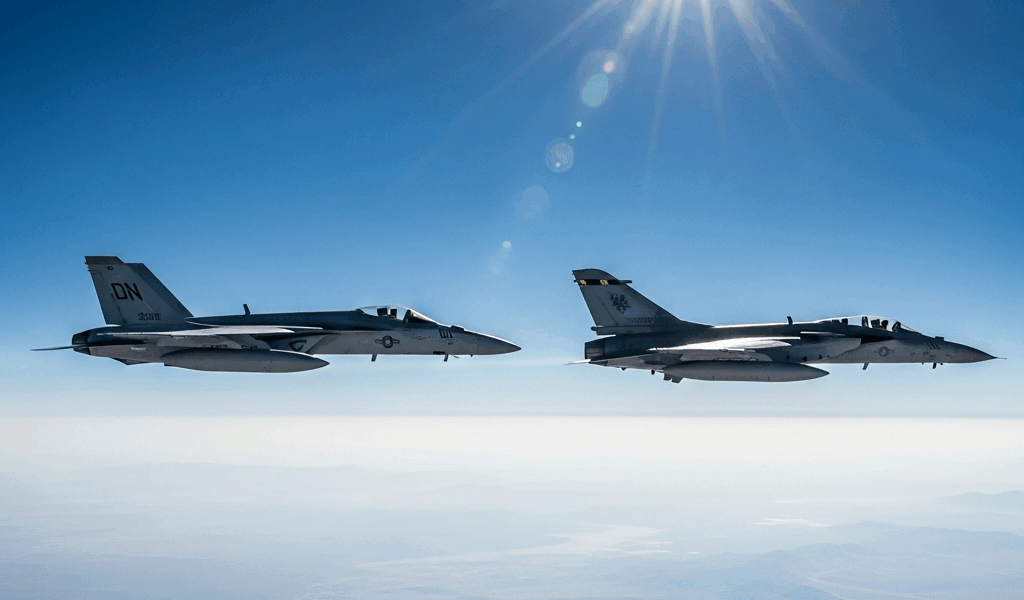
DCS World F/A-18 vs F-16 — Which Module to Buy First
Buy the F/A-18 First — Here Is Why
The DCS World F/A-18 vs F-16 debate has gotten complicated with all the contradictory forum noise flying around. Every beginner thread, every Discord server, every Reddit post from someone who just downloaded the free trial and is staring at a $79.99 decision — same arguments, same circular logic, no clean answer. As someone who spent two genuinely painful weeks drowning in forum opinions before finally pulling the trigger on the Hornet, I learned everything there is to know about making this choice the hard way. Today, I will share it all with you.
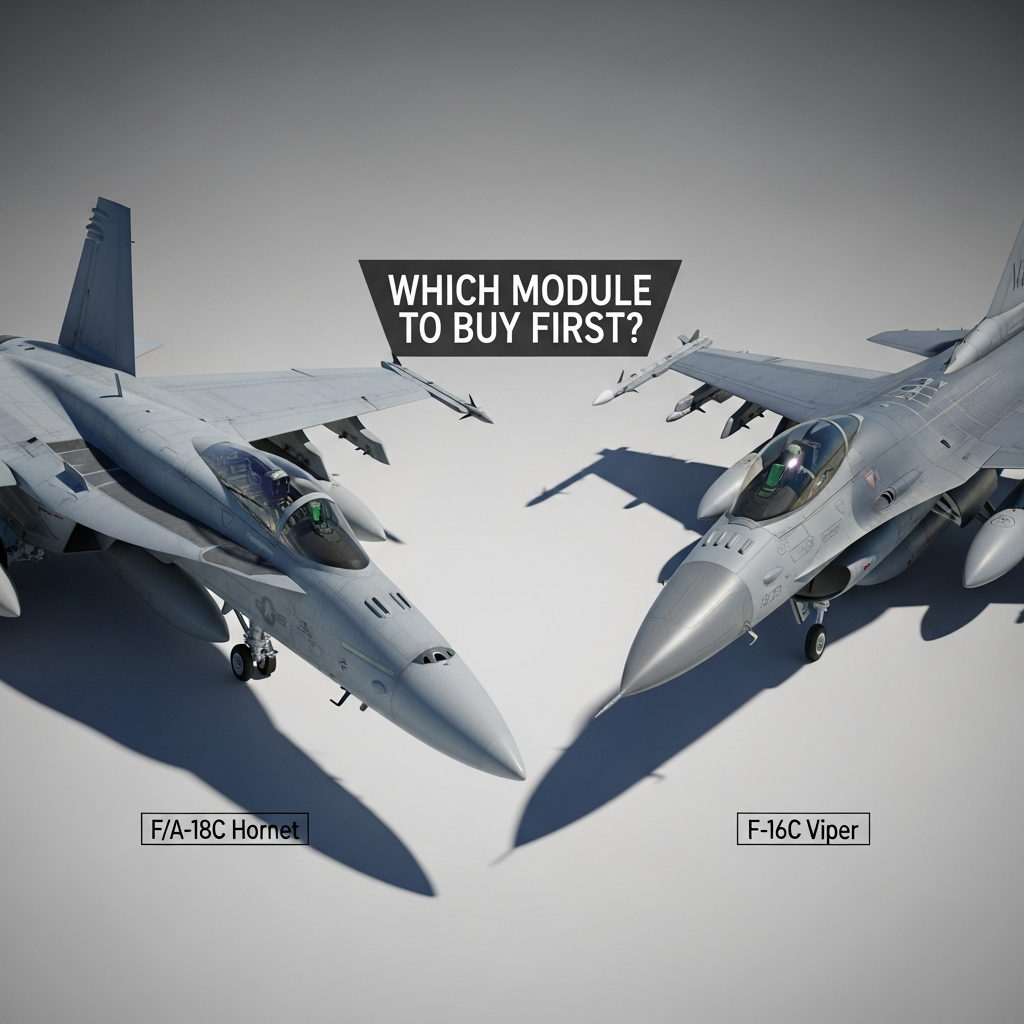
Here is the verdict, upfront, no burial at the end of a long article: buy the F/A-18C Hornet first.
That is the answer. Stop reading here if you want. You have what you need.
But the why matters — at least if you actually want to understand what you are getting into with DCS. The Hornet is more forgiving to fly. It covers more mission types than any other jet in the sim. Works on both land and carrier. Has the deepest library of beginner tutorials available anywhere, official and community-made. The F-16C Viper is a phenomenal module. It is not the right first module. Real difference between those two statements. So, without further ado, let’s dive in.
The F/A-18C Hornet — Jack of All Trades
Frustrated by my inability to even complete a cold start on my first night, I fumbled through the switch sequence with a Chuck’s Guide PDF open on my second monitor and a mug of coffee I definitely knocked over somewhere around the INS alignment step. Still got airborne within 45 minutes of buying the module. That tells you something real.
The F/A-18C Hornet module — developed by Eagle Dynamics, currently $79.99 on the DCS World store — is the closest thing to a complete military aviation simulator in a single package. Not a simplified version. Not an arcade approximation. A study-level simulation of the actual aircraft, every cockpit system behaving exactly the way it does in real life. What makes it beginner-friendly is not corner-cutting. The real Hornet was engineered with pilot workload management baked into the design, and that philosophy translates directly into the sim. That’s what makes the Hornet endearing to us new players.
Air-to-Air Capability
The Hornet carries the AIM-120C AMRAAM for beyond-visual-range combat. Lock a target on the APG-73 radar, get a firing solution, send the missile, go defensive. Basic BVR employment takes hours to learn. Not weeks. You also get the AIM-9X Sidewinder for close-range work — with a helmet-mounted cueing system that lets you slave the seeker off-boresight. Look at a target, shoot at it, without pointing your nose directly at it first. Genuinely fun. Tactically significant.
The M61A1 Vulcan 20mm cannon is modeled accurately. Gun employment takes practice — it always takes practice, on every platform, forever. But the HUD symbology, the funnel, the LCOS reticle, is intuitive once you understand what you are actually looking at. The Hornet’s flight model makes holding a tracking solution easier than the Viper’s more sensitive controls. Not easier like cheating. Easier like the aircraft is not actively fighting you while you try to learn.
Air-to-Ground Capability
This is where the Hornet separates itself from most other jets in DCS. The weapons list is genuinely long. GBU-38 JDAMs for GPS-guided bombing from altitude. GBU-12 Paveway II laser-guided bombs for precision strikes. AGM-65F and AGM-65E Mavericks for standoff anti-armor work. Mk-82 and Mk-83 unguided iron bombs for when you just want to drop something heavy on something. Rockets. The AGM-88C HARM for suppression of enemy air defenses — though the Viper does SEAD better, and I’ll get to that.
The ATFLIR targeting pod — the AN/ASQ-228 — integrates cleanly with the stores management system. Once you understand the basic sensor-to-stores workflow, finding a target, lasing it, and putting a Paveway through a specific window becomes repeatable. Satisfying in a way that makes you immediately want to fly another sortie.
Carrier Operations
Nobody talks about this enough when comparing these two jets, honestly. The Hornet lands on carriers. The Viper does not. That single fact reshapes your entire experience on the Persian Gulf and Marianas maps — both built around carrier strike group scenarios. Carrier traps are the most skill-intensive thing you will do in DCS short of actual air combat maneuvering. Catching the three-wire at 145 knots, on-speed AoA, meatball centered. Deeply difficult. Deeply rewarding. The Viper does not give you that option. For a first module, that matters more than people admit.
The F-16C Viper — Speed and Energy
Probably should have opened with this section, honestly — given how obvious my Hornet bias has been so far. The F-16C Viper module is excellent. That needs to be said clearly before any comparison is useful.
The Viper is faster. Not marginally. Meaningfully faster in a clean configuration, with better energy retention through turns and a higher sustained climb rate. In a simulated BVR engagement against another human pilot who knows what they are doing, energy advantage is real. The APG-68 radar paired with the HTS pod for SEAD work is arguably the best suppression platform in the current DCS module lineup. If hunting SAM sites and killing radars with AGM-88 HARMs using actual emitter targeting — not pre-briefed coordinates — is specifically what you want to do, the Viper does it better than the Hornet. Full stop.
Air-to-Air in the Viper
The Viper carries the same AIM-120C and AIM-9X loadout as the Hornet. The APG-68 radar interface uses different scan patterns and submodes — but the employment logic is similar enough that experience in one translates to the other without starting from zero. The flight model rewards aggressive stick input differently than the Hornet. Smaller aircraft, lighter aircraft, and it feels like one. When you get it right, it feels electric. When you get it wrong at low altitude and high angle of attack, it departs controlled flight fast. Very fast.
Air-to-Ground in the Viper
The Viper supports the LANTIRN pod and the AN/AAQ-28 Litening pod. Solid sensor capability for precision ground attack. JDAMs, Paveways, Mavericks — loadout options are comparable to the Hornet in most respects. The cockpit workflow for delivering precision weapons is more involved on the Viper, though. MFD button logic and stores management interface are organized differently. And the documentation — both official and community-produced — is thinner than the Hornet’s. Not thin. Thinner.
That one word matters when you are learning at 11pm and stuck on something specific.
No Carrier, No Compromise
The Viper operates from conventional runways. On Nevada, Syria, and the Caucasus maps, that limitation is invisible — you may not care. On scenarios built around carrier strike groups, the Viper sits on the bench. If there is any chance you want carrier operations in your DCS experience, carry that into the purchase decision. It will matter eventually.
Learning Curve Compared
Don’t make my mistake. Early in my DCS time, I tried to learn everything simultaneously — cold start, navigation, radar, weapons employment, carrier operations, formation flying — all crammed into the first two weeks. The result was surface-level familiarity with everything and actual competence at nothing.
The Hornet’s design philosophy actively works against that trap. The angle-of-attack indexer — the three-light indicator on the left side of the HUD — uses green, amber, and red to tell you whether you are flying at the correct AoA for on-speed flight. On approach to a carrier or a runway, you get immediate, unambiguous feedback. No interpreting airspeed in context. No cross-referencing vertical velocity. The aircraft just tells you whether you are right or wrong. That is a teaching tool built into the jet.
High-AoA Handling
The Hornet’s departure resistance is well-documented, and it is real in the sim. Pull hard, get slow, depart the normal flight envelope — the fly-by-wire system has hard limiters that make certain kinds of pilot-induced departure genuinely difficult to achieve by accident. New pilots break the Hornet less often. They spend more time learning weapons employment and less time respawning after an unrecoverable spin at 800 feet.
The Viper is not unforgiving. But it is less forgiving. Relaxed static stability — the same design choice that makes it so maneuverable — means sloppy stick input at the edges of the envelope costs you more. Crossed controls at slow speed, ham-fisted rudder in a break turn — the Viper will depart. Recovery requires specific inputs you need to already know. Learning those inputs while simultaneously learning radar employment, weapons delivery, and cockpit management is a significant cognitive load to carry when you are new.
Tutorial Quality and Community Documentation
Grim Reapers on YouTube has over 200 Hornet tutorial videos. Chuck’s Guide for the F/A-18C runs several hundred pages and gets updated regularly. The official DCS interactive training missions for the Hornet cover basic flight, weapons employment, carrier operations, and instrument flight. The Viper’s documentation is not thin — but it is thinner. I’m apparently someone who learns by watching tutorials at midnight, and the Hornet’s resource library works for me while the Viper’s documentation never quite covered the specific problem I had on any given session.
Frustrated by a radar lock issue I could not resolve after an hour of troubleshooting, I found the exact answer in a 45-minute Hornet tutorial video within the first ten minutes. That resource density is worth real money when you are starting out.
What About the F-14 Tomcat?
But what is the F-14 question doing in every beginner thread? In essence, it’s Top Gun nostalgia colliding with the fact that the Heatblur F-14B module — also $79.99 — is arguably the most technically impressive third-party module ever made for DCS. But it’s much more than a nostalgia purchase, and that cuts both ways.
Do not buy it first.
The F-14 was designed to be operated by a pilot and a radar intercept officer working in coordination. In DCS, you fly it solo with an AI RIO named Jester, or you crew it with a human partner in the back seat. Jester is sophisticated. Jester is also not a human — there are things it handles awkwardly or slowly that a real RIO would manage instantly. Learning to communicate with Jester while managing an aircraft with more complex handling characteristics than either the Hornet or the Viper is a genuine mountain for a new player.
The F-14’s flight model is exceptional. At high alpha, the wing-sweep geometry and handling characteristics are unlike anything else in the sim. Getting to the point where you can actually exploit those characteristics takes real time investment, though. The AWG-9 radar is powerful and has been in the sim longer than the Hornet’s APG-73 — but its interface is from a different era of avionics design entirely, and the learning curve reflects that honestly.
Buy the F-14 second or third. Come back after a hundred hours in the Hornet, when you understand how DCS structures its systems. At that point, the Tomcat will be the most rewarding thing you have done in a flight simulator. Right now, it will frustrate you into quitting. That was my experience watching a friend try to start there. He quit. He came back six months later with Hornet hours under his belt and finally got it. Don’t make his mistake either.
The Verdict — F/A-18C Hornet for First-Time Buyers
The F/A-18C Hornet at $79.99 is the correct first module for the overwhelming majority of new DCS players. Covers every mission role — air-to-air, air-to-ground, carrier operations, SEAD, close air support. Best beginner documentation in the sim. Flight model that is forgiving in exactly the ways that matter most when you are still learning what all the buttons do, without dumbing down the underlying simulation at all. And the skills you build in the Hornet transfer directly to the Viper when you eventually buy that module too. That’s what makes the Hornet endearing to us new players.
Buy the Hornet. Learn the Hornet. Put in fifty hours — at least if you actually want to appreciate what the Viper and the Tomcat are doing differently. Then come back to those modules with the experience to understand what makes each of them genuinely special. That is the right path through this sim. Someone should have told me clearly and early instead of sending me into three weeks of forum archaeology.
The answer was always the Hornet. Now you have it on the first page.
If you are still choosing a first aircraft rather than only those two jets, use the beginner DCS module decision guide to compare fidelity, missions, trials and platform restrictions.




Stay in the loop
Get the latest ultimate flight simulators updates delivered to your inbox.