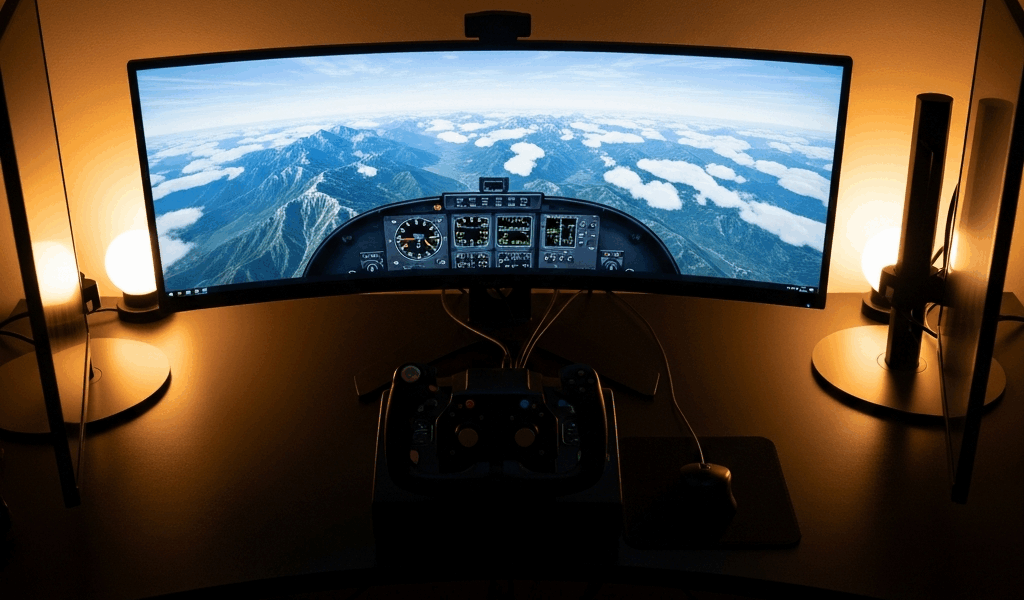
The Three Approaches — Ultrawide, Triple, or VR
Finding the best monitor for flight simulator has gotten complicated with all the spec sheets, forum arguments, and sponsored reviews flying around. As someone who burned through three different display setups over fourteen months, I learned everything there is to know about matching a monitor to a flight sim rig. Today, I will share it all with you.
But what is the right monitor for flight sim? In essence, it’s whichever display stops making you feel like you’re peering through a mail slot at the sky. But it’s much more than that — it’s a GPU decision disguised as a shopping question, and getting it wrong is an expensive lesson.
I learned this the hard way. Bought a 1440p 144Hz gaming monitor — a nice one, $480 at the time — and immediately felt like I was flying the Boeing 787 through a cardboard tube. Claustrophobic doesn’t cover it.
Three philosophies exist here. Ultrawide: one monitor, clean desk, decent immersion. Triple setup: real peripheral vision, the kind that matters when you’re turning final on Runway 28L. VR: total presence at a GPU cost that’ll make you question your life choices. Each one absolutely nails something and quietly fails at something else. That’s what makes this choice so endearing to us flight sim obsessives — there’s no obvious winner. So, without further ado, let’s dive in.
Probably should have opened with this section, honestly — the GPU math changes everything about what’s actually viable for your current rig.
Best Ultrawide for Flight Sim
Most people land here. It’s the sane middle path — real field-of-view gains over a standard 16:9 panel without the desk demolition project that triple monitors require.
Two sizes run the market. The 34-inch at 3440×1440 and the 49-inch at 5120×1440. I started on the 34-inch. Sits at roughly 120 degrees horizontal — genuinely better than stock, still not quite the wing-tip-to-wing-tip view you get in real flight, but close enough that you stop noticing after about an hour.
The 49-inch changes the equation entirely. Somewhere between $700 and $1,200 depending on the panel, it spans around 165 degrees. That’s legitimately close to actual cockpit geometry. The catch hits fast though: you need a desk that can actually hold the thing. I measured my setup three times before ordering. My desk was 48 inches wide. The monitor is 56 inches. You do the math — I clearly didn’t do it fast enough.
Curvature matters more than the spec sheet suggests. Flight sim cockpits wrap around you by design. A flat ultrawide feels weirdly disconnected, like watching a movie through a window rather than sitting inside the plane. Curved panels — the 1800R curve is standard — let your eyes settle naturally across the whole screen without the edges going soft. The Dell S3424DWC is the one I keep recommending: 34-inch, 1800R, 120Hz native, runs about $800. Not glamorous. Works every single time.
For the 49-inch tier, the Samsung Odyssey OLED G9 (around $1,100–$1,300) and the LG UltraGear (closer to $900) both handle MSFS 2024 well. The OLED earns its price in night operations — the black levels are genuinely different. The LG is lighter on your GPU and probably the smarter pick if you’re not running an RTX 4080.
What actually matters on the spec sheet for flight sim specifically:
- 1800R or tighter curve — flat hurts immersion more than you’d expect
- Minimum 100Hz refresh rate (VRR helps with frame time consistency during heavy weather)
- Native resolution support in MSFS 2024 — some older drivers bottleneck at ultrawide res
- Height-adjustable stand — eye level or slightly below for proper cockpit ergonomics
- USB-C with power delivery if you’re running a laptop-based sim setup
Performance reality for ultrawide: 60 fps at high settings in MSFS 2024 with an RTX 4070 on the 34-inch. Jump to the 49-inch at 5120×1440 and you’re looking at RTX 4080 territory minimum. Doable. Not brutal. Your hardware survives.
Triple Monitor Setup — Maximum Field of View
Three monitors unlock something an ultrawide physically cannot — actual peripheral vision. Flying traffic patterns, the descending turns around an airport on final approach, benefits enormously from seeing the runway reference sitting off to your right while your nose is still pointed at the horizon. That’s what makes triple setups endearing to us pattern-flying obsessives.
The standard rig is three 27-inch 1440p monitors in landscape orientation with software bezel compensation. You’re looking at roughly 180 degrees horizontal. This is the configuration you see in serious sim cockpits at flight training centers.
The math is simple. Three 27-inch displays equals about 81 inches wide. Your desk needs to run 84 to 90 inches before you’ve added a yoke or stick on either side. I made the mistake of assuming my U-shaped desk would handle it. It didn’t. Spent three weeks with one monitor nested awkwardly into the curve before I tore the whole thing apart and rebuilt it. Don’t make my mistake — measure the actual footprint including the monitor stands, not just the screen width.
32-inch triple is also viable and honestly, I’d go that direction now. Fewer bezels to compensate for, bigger peripheral real estate. Wider total footprint — 96-plus inches — but the immersion jump earns it if the space exists.
GPU requirements climb hard here. You’re pushing 11,520×1440 across three panels. That’s nearly double the pixels of a single 34-inch ultrawide. RTX 4080 at 60 fps high settings is the realistic floor. RTX 4090 if you want consistent frame times and full visual quality without babysitting settings.
Bezel compensation deserves a real conversation. The physical black gap between monitors splits your forward view. TrackIR or head tracking helps — your head movement compensates naturally for what the bezels interrupt. Without it, the center display feels weirdly isolated. MSFS 2024 has built-in bezel compensation under graphics settings, but aftermarket FOV adjustments help too. I’m apparently very sensitive to misaligned bezels and TrackIR works for me while software-only compensation never quite does.
Specific setup I’d recommend:
- Three ASUS VP28UQGL or BenQ PD2700U displays — 27-inch, 1440p, 60Hz minimum
- Ergotron triple monitor arm or similar sturdy mount ($300–$500)
- Stands angled slightly inward to reduce visible bezel gap perception
- GPU capable of pushing 11,520×1440 at your target frame rate
- TrackIR or Tobii eye-tracking — not required, but changes the experience dramatically
Cost breakdown: three monitors run $600–$900, the mount is around $400, cables and adapters add $100, TrackIR software is $150. You’re at $1,250–$1,550 before the GPU. More expensive than ultrawide upfront — less expensive than VR when you account for the full system.
VR for Flight Sim — The Best Experience You Might Not Be Ready For
VR is the future of flight sim. Not casually saying that. I’ve logged 140 hours in MSFS 2024 with a headset strapped to my face. The immersion isn’t comparable to anything else. The performance cost is genuinely brutal.
Current options worth knowing: Meta Quest 3 at $500, HP Reverb G2 at $600 used or $800 new if you can find stock, Pimax Crystal at $1,200. Don’t dismiss the Quest 3 — it’s not the highest resolution headset on the market, but it works without a cable running to your face and the inside-out tracking holds up well enough for cockpit use.
Resolution is always a tradeoff in VR. Quest 3 runs 1200×1080 per eye. Reverb G2 runs 2160×2160 per eye. The Reverb wins for raw clarity. The Quest 3 wins for long-session comfort — no cable tangling when you turn your head to check the wing, and heat buildup is noticeably lower over a four-hour transatlantic route.
Here’s what nobody actually tells you upfront about VR flight sim: the performance hit is exponential, not linear. You’re not rendering one high-resolution image. You’re rendering two slightly offset images simultaneously at 90 fps minimum. Drop below that and motion sickness arrives fast — within minutes, not hours. That’s not a preference. That’s your vestibular system rejecting bad frame times.
MSFS 2024 in VR across different hardware tiers:
- RTX 4070 — 45 fps medium settings, reprojection carries it to 90 fps. Acceptable. Noticeable lag on fast head movements.
- RTX 4080 — 60–70 fps high settings with reprojection. Smooth most of the time. Stutters at busy airfield load-in.
- RTX 4090 — 80–90 fps high settings native. Genuinely smooth. No meaningful compromise.
There’s a gap between the RTX 4080 and RTX 4090 that simply doesn’t exist in flat-screen gaming. In VR, that gap is the difference between your brain accepting the experience or quietly rejecting it. Reprojection — the technology that generates synthetic frames to reach 90 fps — works. Over four hours, it adds up. You feel fatigue you can’t quite identify.
I tested this directly. Two hundred hours on RTX 4080 with reprojection, then switched to RTX 4090 native 90 fps. The difference in fatigue after a four-hour flight was shocking. Didn’t realize how much the synthetic frames were costing me until they disappeared.
Cockpit interaction in VR feels strange for exactly 30 minutes. You reach into the panel, flip switches, turn the yoke — your virtual hands appear and follow your real hands with maybe 10 milliseconds of lag. After that 30-minute window, your brain stops flagging it as weird and it becomes instinct. After a month, flat-screen sim feels like watching someone else fly.
Setup requirements are real: clear space around your chair — minimum 6×6 feet, even for a fully seated rig with yoke and pedals — elbow room for head movement without hitting anything, and a yoke mount that keeps the hardware stable while you’re not looking at it. I mounted mine on a keyboard tray bolted to the desk. Halo-style headsets eliminate face pressure for long sessions. That matters more than resolution after hour two.
The downsides are genuine: cable management with the Reverb G2 is a headache, heat buildup after two hours is real, GPU requirements are the highest of any option here, and the learning curve for VR control schemes takes a few sessions. I’ve introduced three friends to VR flight sim. One bought a full setup within a month. Two went back to triple monitors. One ended up on a 49-inch ultrawide. All three are still flying. That’s something.
GPU Requirements — What You Actually Need for Each Setup
This is where I need to be blunt. Your monitor choice is really a GPU choice wearing a display as a disguise.
Ultrawide 34-inch at 3440×1440, 60 fps, high settings: RTX 4070. This is the entry point to sim-serious flying. The 4070 runs $350–$450 used or $550 new. If you’re already on a 4070 Super, call it done and order the monitor.
Ultrawide 49-inch at 5120×1440, 60 fps, high settings: RTX 4080. Budget $600–$800 for the GPU. Resolution nearly doubles from the 34-inch. Your card works for it. This is where flight sim stops being a side hobby and becomes the thing your entire PC was built around.
Triple 27-inch at 11,520×1440, 60 fps, high settings: RTX 4080 Super or RTX 4090. You’re looking at $800–$1,600 for the GPU alone. Serious money. But you’re also building a cockpit view that rivals VR without motion sickness, headset heat, or cable management.
VR at 90 fps native, high settings, no reprojection: RTX 4090. Around $1,600 new, $1,200–$1,400 used. This is the GPU ceiling — even the 4090 meets its limits with max settings and demanding third-party add-ons. You’ll accept high instead of ultra or live with occasional reprojection during complex scenery.
VRAM is the second piece. MSFS 2024 in VR and at extreme resolutions eats VRAM aggressively. RTX 4070 has 12 GB. RTX 4080 has 16 GB. Don’t buy a 4070 for a 49-inch ultrawide build — you’ll hit VRAM limits and see stuttering. In VR specifically, stuttering means motion sickness. That’s not a minor inconvenience.
CPU is the third variable. Flight sim is surprisingly CPU-light compared to competitive titles. A Ryzen 7 5700X or an Intel i7-13700K handles it. But pair a top-tier GPU with a weak processor and heavy scenery areas will expose the bottleneck fast. Aim for a 12-core modern chip minimum — don’t let the CPU be the reason a $1,600 GPU underperforms.
Frame rate reality: 60 fps in flight sim feels different than 60 fps in a shooter. The world moves slowly. The camera is stable. 50 fps is honestly acceptable. 60 fps is smooth. 90 fps in VR is non-negotiable. 120-plus fps on a flat display is genuinely overkill — target 60 and spend the GPU budget on resolution instead.
The Decision Matrix — Which One Is Right For You
Ultrawide 34-inch if: your desk is under 55 inches wide, you want an upgrade without rebuilding everything, you fly long-haul routes where peripheral vision matters less, and you have an RTX 4070 or better already. Cost: $800–$900 for the monitor, RTX 4070 required.
Ultrawide 49-inch if: you have desk space — and I mean actually have it, not “probably have it” — you want a single-monitor solution with real immersion, you’re comfortable spending $1,200 on a display, and you have an RTX 4080 minimum. Cost: $1,200 monitor, RTX 4080 required.
Triple monitors if: the desk space exists for a 90-inch-plus spread, you fly traffic patterns regularly and peripheral vision matters to your flying, you’re building a permanent cockpit rig and not moving it, and you have an RTX 4080 Super or better. Cost: $1,500–$2,000 all-in for three monitors, mounts, and TrackIR.
VR if: you have floor space and actual headroom, you’re running an RTX 4090, you’re okay with the motion sickness learning curve (it passes — give it a week), you can tolerate halo strap adjustment time before each session, and you want the closest thing to actual flight that money currently builds. Cost: $2,000–$2,500 all-in with headset and GPU.
My choice? I fly the 49-inch ultrawide for long-haul routes, triple monitors for pattern work and training flights, and VR for special occasions — good lighting, three uninterrupted hours, nobody knocking on the door. That’s three separate systems, which is excessive and I know it. But each one scratches a genuinely different itch.
Start with ultrawide. It’s the gateway drug. Then decide if you need more.

Stay in the loop
Get the latest ultimate flight simulators updates delivered to your inbox.