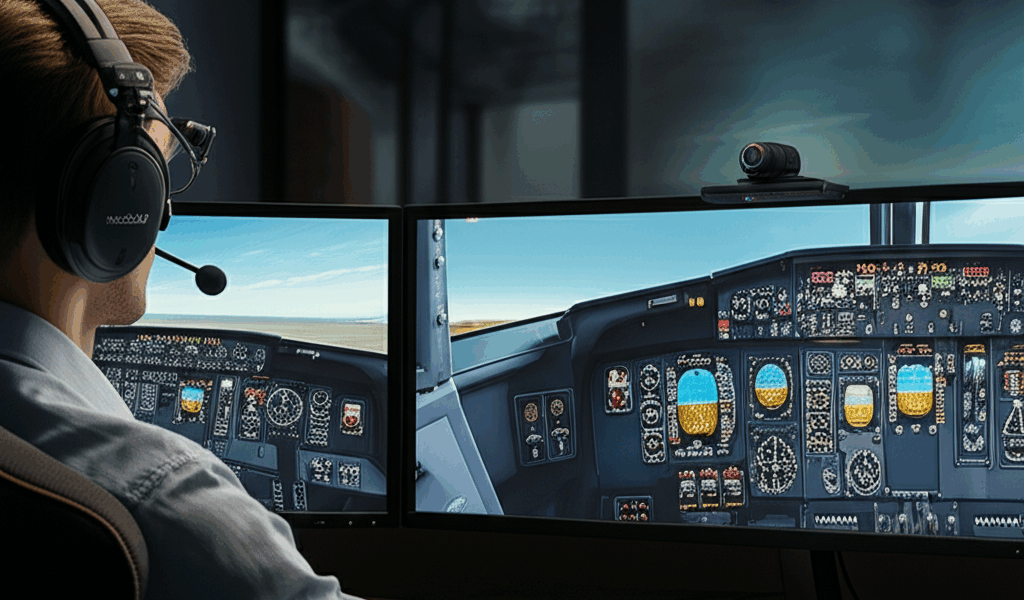
Why Head Tracking Transforms Flight Simulation
The moment you try head tracking, you’ll wonder how you ever flew without it. Instead of wrestling with hat switches to look around the cockpit, you simply turn your head. Glance left to check traffic on final, look down at your instruments, peer over the glareshield during approach—all with natural head movements. Three technologies dominate this space: TrackIR, Tobii eye tracking, and the budget-friendly DelanClip.
TrackIR: The Established Standard
Natural Point’s TrackIR has been the go-to head tracking solution for flight simmers since 2001. The system uses an infrared camera mounted on your monitor that tracks reflective points worn on your head, typically via a clip attached to a headset.
TrackIR 5 Specifications:
- 120 Hz tracking rate for smooth, lag-free response
- Six degrees of freedom (6DOF) tracking
- Works with 200+ supported games out of the box
- Includes both clip and TrackClip Pro options
- Price: Approximately $150-170 USD
Strengths: TrackIR offers rock-solid reliability and near-universal game support. The software allows extensive curve customization, letting you tune exactly how much in-game movement corresponds to your head movement. Most users dial in settings where small head movements produce larger view changes, keeping physical movement comfortable during long sessions.
Weaknesses: The clip-based tracking requires wearing something on your head—either the basic clip on a headset or the separate TrackClip Pro on a hat. Direct sunlight can interfere with IR tracking, requiring window blinds in some setups. The price point is also significant for what amounts to a camera and some reflectors.
Tobii Eye Tracker 5: The Premium Modern Option
Tobii approaches the problem differently, using sophisticated eye and head tracking technology in a slim bar that attaches below your monitor. Originally developed for accessibility and gaming, it’s found a devoted following among flight simmers.
Tobii Eye Tracker 5 Specifications:
- Combined eye and head tracking
- 133 Hz tracking rate
- USB-C connection with magnetic mounting
- No head-worn accessories required
- Price: Approximately $230-250 USD
Strengths: The biggest advantage is freedom—no clips, no headset requirements, nothing on your head. Setup is remarkably simple: stick the magnetic bar to your monitor and calibrate. Tobii’s eye tracking adds another dimension, allowing your gaze to influence view direction for even more natural cockpit scanning.
Weaknesses: Game support is narrower than TrackIR, though major simulators like MSFS 2020/2024 and DCS World work natively. The eye tracking component requires specific lighting conditions and doesn’t work well with all glasses. Some users find the combined eye/head tracking takes adjustment, preferring pure head tracking.
DelanClip: The Budget Champion
DelanClip offers TrackIR-style functionality at a fraction of the cost. It’s a small business producing IR LED clips and modified PlayStation Eye cameras that work with the free OpenTrack software.
DelanClip Specifications:
- Active IR LED clip (battery or USB powered)
- Modified PS3 Eye camera with IR filter
- Works with free OpenTrack software
- 6DOF tracking like TrackIR
- Price: $50-70 USD for complete kit
Strengths: The value proposition is undeniable—you get 90% of TrackIR’s functionality for 35% of the price. The active LED design means it works in various lighting conditions without sunlight interference. OpenTrack software is surprisingly powerful, with curve editors matching TrackIR’s capabilities.
Weaknesses: Build quality reflects the price difference. The PS3 Eye camera maxes at 75 Hz (vs TrackIR’s 120 Hz), though most users can’t perceive this difference. Initial setup requires more tinkering than plug-and-play solutions. Support is limited to email with a small operation.
Head-to-Head Comparison
Tracking Quality: In blind testing, most users struggle to distinguish between TrackIR and DelanClip once properly configured. Tobii feels different due to its eye tracking component but isn’t necessarily better or worse—just different.
Setup Complexity: Tobii wins for simplicity—attach, calibrate, fly. TrackIR is straightforward but requires the head clip. DelanClip needs the most initial configuration but isn’t difficult for anyone comfortable with software settings.
Comfort: Tobii wins definitively with no head-worn hardware. TrackIR and DelanClip both require clips, though the lightweight designs are easily forgotten during flight.
Value: DelanClip offers extraordinary value for budget-conscious simmers. TrackIR justifies its premium through polish and support. Tobii’s higher price buys convenience and eye tracking technology.
Which Should You Buy?
Choose TrackIR if: You want proven reliability, extensive game support, and don’t mind the head clip. The TrackIR ecosystem is mature with excellent documentation and community support.
Choose Tobii if: Convenience is paramount, you’re willing to pay the premium, and your primary simulators support it. The glasses-free experience and eye tracking integration appeal to many users.
Choose DelanClip if: Budget matters, you’re comfortable with basic setup procedures, and you want TrackIR-level performance without TrackIR-level pricing. The value here is exceptional.
The DIY Alternative
For the truly budget-conscious, completely DIY solutions exist. A modified webcam with visible-light LEDs and OpenTrack can work, and some builders have created functional trackers for under $20 in parts. However, the time investment rarely makes sense when DelanClip exists at its price point.
Final Verdict
Any head tracking is better than no head tracking. The immersion improvement is dramatic regardless of which system you choose. If forced to recommend one solution for most flight simmers, DelanClip offers the best balance of performance, price, and practicality. Those with larger budgets won’t regret TrackIR’s polish or Tobii’s convenience.
Start with what fits your budget, and you’ll quickly wonder why you waited so long to free yourself from hat switches.



Stay in the loop
Get the latest ultimate flight simulators updates delivered to your inbox.