Choosing Your First DCS Military Module
DCS World’s military aircraft modules represent the pinnacle of flight simulation fidelity. But with modules costing $50-80 each and requiring dozens of hours to master, choosing your first purchase matters.
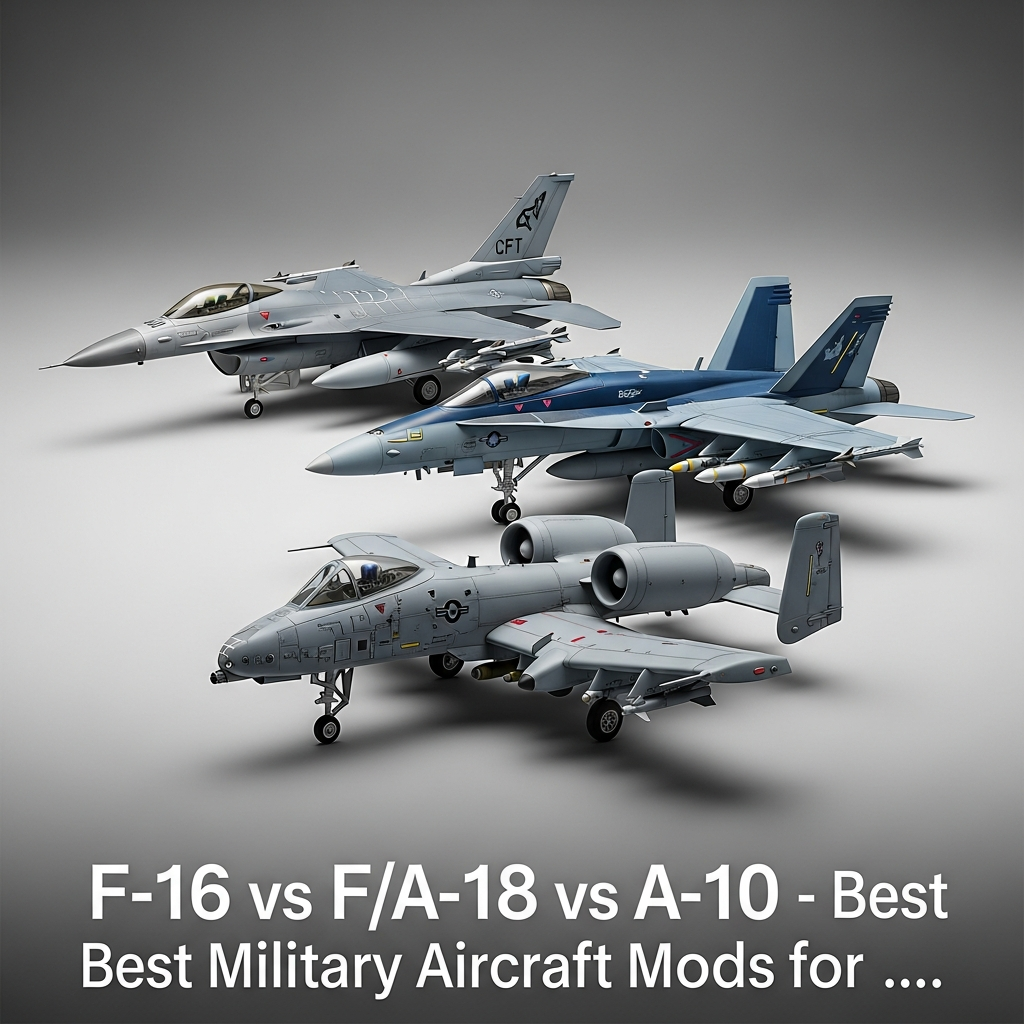
The F-16C Viper, F/A-18C Hornet, and A-10C Warthog represent three distinct philosophies of military aviation. Each excels in specific roles. Each requires different skills. And each attracts different types of virtual pilots. Here’s how to choose which module deserves your money and your learning investment.
The F-16C Viper: Multirole Agility
What the Module Offers
Eagle Dynamics’ F-16C Viper module simulates the Block 50 variant of America’s most numerous fighter. You get full clickable cockpit, realistic avionics, authentic weapons employment, and flight model based on real F-16 performance data.
The Viper handles air-to-air combat with AIM-120 AMRAAM and AIM-9X Sidewinder missiles. It delivers precision air-to-ground strikes with GPS-guided JDAMs, laser-guided Mavericks, and unguided rockets. It performs SEAD (Suppression of Enemy Air Defenses) missions with AGM-88 HARM anti-radiation missiles.
Current module state: Mature and feature-complete. Eagle Dynamics continues adding features and weapons, but core systems work reliably. VR performance is excellent.
Learning Curve
The F-16 requires moderate learning investment. Start-up procedures take 5-10 minutes once learned. Weapons employment is relatively straightforward compared to older aircraft. The MFD (Multi-Function Display) interface organizes information logically.
Air-to-air combat in the F-16 rewards energy management and situational awareness. The Viper accelerates rapidly, climbs well, and turns effectively at most speed regimes. But it bleeds energy quickly in sustained turns—learning when to fight and when to extend takes practice.
Air-to-ground missions benefit from excellent sensors and targeting systems. The targeting pod displays high-resolution video. GPS-guided weapons hit precisely where you designate. The challenge isn’t employing weapons—it’s coordinating complex missions with threat avoidance and fuel management.
Estimated time to basic competence: 20-30 hours
Estimated time to advanced proficiency: 100+ hours
Best For
Pilots wanting versatility. The F-16 performs every mission adequately and most missions well. If you don’t know what role you’ll enjoy most, the Viper lets you try everything without buying multiple modules.
Online multiplayer pilots. The F-16 fits into any mission—CAP (Combat Air Patrol), strike packages, SEAD, CAS (Close Air Support). Squadron commanders love Viper pilots because they fill gaps in any tasking.
Pilots transitioning from simpler aircraft. The F-16’s systems complexity sits between basic trainers and more complex modules like the F-14. It teaches modern fighter employment without overwhelming new simmers.
The F/A-18C Hornet: Carrier Capable Jack-of-All-Trades
What the Module Offers
Eagle Dynamics’ F/A-18C Hornet simulates the Navy/Marine Corps multirole strike fighter. Beyond land-based operations, the Hornet adds carrier operations—catapult launches, arrested landings, and Case I/II/III recovery procedures.
The Hornet’s weapons loadout mirrors the F-16: AMRAAMs and Sidewinders for air-to-air, JDAMs and Mavericks for air-to-ground, plus HARMs for SEAD. It adds Harpoon anti-ship missiles and can perform aerial refueling as tanker or receiver.
The Hornet’s distinctive feature is its multi-sensor integration. The radar, targeting pod, and helmet-mounted display share target information seamlessly. You can acquire, identify, and engage targets faster than in most other modules.
Current module state: Feature-complete and mature. Carrier operations work reliably. Regular updates continue refining systems.
Learning Curve
The Hornet’s complexity equals the F-16 for basic operations but adds carrier procedures that significantly extend learning time.
Carrier landings require precise speed control, lineup, and glideslope management. The Hornet’s fly-by-wire helps, but landing on a pitching carrier deck at night in weather separates casual simmers from dedicated virtual naval aviators.
Air-to-air employment benefits from excellent sensors and the JHMCS (Joint Helmet Mounted Cueing System). Point your head at a target, designate it, and employ weapons off-boresight. This makes close-range combat more intuitive than aircraft requiring radar designation only.
Air-to-ground missions use similar weapons to the F-16, but the Hornet’s sensor fusion and targeting systems sometimes make employment simpler. The ATFLIR targeting pod integrates perfectly with weapons systems, streamlining the kill chain.
Estimated time to basic competence (land-based): 20-30 hours
Estimated time including carrier ops: 40-60 hours
Estimated time to advanced proficiency: 120+ hours
Best For
Pilots wanting the full naval aviation experience. If “Top Gun” made you want to fly off carriers, the Hornet is your module. Carrier operations add challenge and immersion land-based flying can’t match.
Pilots who value sensor integration. The Hornet’s systems work together better than most modules, reducing cockpit workload during complex missions.
Virtual squadrons flying mixed missions. Like the F-16, the Hornet fills any role adequately. But its carrier capability adds mission variety other aircraft can’t offer.
The A-10C Warthog: Close Air Support Specialist
What the Module Offers
The A-10C Warthog by Eagle Dynamics simulates the Air Force’s dedicated close air support aircraft. Unlike the F-16 and F/A-18, the A-10 doesn’t pretend to do everything—it does one thing exceptionally well: providing precise firepower to support ground forces.
The GAU-8 30mm cannon carries 1,150 rounds of armor-piercing ammunition. The A-10 can linger over battlefields for hours (real A-10s have 2+ hour loiter times; DCS models this accurately). Its armor protects against ground fire that would destroy other aircraft.
Weapons loadout emphasizes air-to-ground: Mavericks for armor, JDAMs for structures, rockets and bombs for softer targets, and the GAU-8 for everything. The A-10C can carry Sidewinders for self-defense, but dogfighting isn’t its strength.
The A-10C’s distinctive feature is the TAD (Tactical Awareness Display) integrating sensor data, target locations, friendly positions, and threats into a single display that’s revolutionary for CAS coordination.
Current module state: Extremely mature. The A-10C was one of DCS’s first full-fidelity modules and has been refined through years of updates. Two versions exist: the legacy A-10C and newer A-10C II featuring upgrades including better targeting pod and improved cockpit displays.
Learning Curve
The A-10C is simultaneously DCS’s easiest and hardest module.
Flying the A-10 is easy. It’s slow (350 knots cruise, 400 knots maximum), stable, and forgiving. Start-up takes 15-20 minutes initially but becomes routine. You won’t die from losing control—the A-10 wants to fly straight and level.
Mastering the A-10C’s systems is hard. The TGP (Targeting Pod) has dozens of modes. The CDU (Control Display Unit) requires specific page sequences for weapons employment. The TAD integration with datalink and target handoffs from JTACs (Joint Terminal Attack Controllers) demands study.
But this complexity serves purpose. Once mastered, the A-10C delivers precision CAS that other modules can’t match. You can identify targets at 10 miles, coordinate with ground controllers, deconflict with friendlies, and put ordnance exactly where needed without blue-on-blue incidents.
Estimated time to basic competence: 30-40 hours
Estimated time to advanced proficiency: 80-100 hours
Estimated time to master TAD and complex CAS: 150+ hours
Best For
Pilots who want depth over breadth. The A-10C rewards system mastery and tactical employment more than raw flying skill.
Pilots who enjoy supporting ground operations. If you find satisfaction in perfectly executed attacks saving virtual troops, the A-10 provides that experience better than any module.
Pilots who fly in organized groups. The A-10C shines in multiplayer environments with ground controllers, forward air controllers, and coordinated strike packages. Solo A-10 missions work fine, but coordinated CAS missions showcase its strengths.
Performance and System Requirements
Frame Rate Performance
All three modules run well on mid-range systems:
F-16C: Excellent performance. Clean cockpit geometry and efficient systems modeling deliver high frame rates even in VR.
F/A-18C: Similar to F-16. Carrier operations can stress systems when multiple aircraft operate simultaneously, but solo flight performs well.
A-10C: Slightly heavier than the fighters due to more detailed cockpit and complex systems. Still runs acceptably on modest hardware.
For VR specifically: All three support VR well. The F-16 and F/A-18 have slight edges due to more modern cockpit implementations.
Required Learning Resources
All three modules include in-game training missions and interactive tutorials. But you’ll want external resources:
Chuck’s Guides: Free comprehensive manuals for all three aircraft
YouTube channels: Grim Reapers, Tactical Pascale, Redkite’s DCS Tutorials
Hoggit Reddit community: Active helpful community answering questions
ED Forums: Official forums with experienced pilots helping newcomers
Multiplayer Ecosystem
Server Populations
All three modules see healthy multiplayer populations:
F-16C: Very popular. Most servers allow F-16s. CAP, SEAD, and strike missions always need Vipers.
F/A-18C: Extremely popular, possibly the most-flown module online. Servers featuring carriers see heavy Hornet presence.
A-10C: Strong but smaller population. CAS-focused servers love A-10 pilots. Combined arms servers integrating ground units especially value Warthogs.
Learning Curve for Multiplayer
F-16 and F/A-18: Jump into multiplayer relatively quickly. Basic weapons employment lets you contribute meaningfully to strike packages within 20-30 hours practice.
A-10C: Requires more preparation. Effective CAS coordination demands system mastery and communication skills. Plan 40-50 hours minimum before attempting complex multiplayer CAS.
Cost Considerations
All three modules retail for $79.99 full price. Regular sales (typically 30-50% off) make them $40-55.
DCS frequently offers trial periods where you can fly modules free for 14 days. Try before buying—especially important for the A-10C, which isn’t for everyone despite being excellent at what it does.
Making Your Choice
Choose the F-16C Viper if you want:
– Versatility across all mission types
– Relatively quick learning curve to basic competence
– Strong multip layer presence and demand
– Modern fighter experience without excessive complexity
– Fast-paced air-to-air and strike missions
Choose the F/A-18C Hornet if you want:
– Everything the F-16 offers plus carrier operations
– Superior sensor integration and helmet cueing
– Naval aviation experience
– Slightly easier weapons employment than F-16
– The most popular multiplayer module
Choose the A-10C Warthog if you want:
– Deep systems simulation rewarding mastery
– Close air support specialization
– Slower-paced tactical missions
– Coordination with ground forces
– Unique flying experience unlike fast jets
The “Wrong” Choice Doesn’t Exist
All three are exceptional modules representing hundreds of hours of development. You can’t go wrong with any of them. The question isn’t which is “best”—it’s which matches your interests and desired experience.
Many DCS pilots eventually own all three (plus dozens of other modules). Your first choice doesn’t lock you in forever. But starting with the module matching your interests ensures you’ll stay motivated through the learning curve required to master DCS’s study-level simulation.
Pick the one that excites you most. The one you’ll want to spend 50+ hours learning. The one where you’ll watch YouTube tutorials at work and study Chuck’s Guide on your phone. That’s your right module—regardless of what anyone else recommends.


Stay in the loop
Get the latest ultimate flight simulators updates delivered to your inbox.