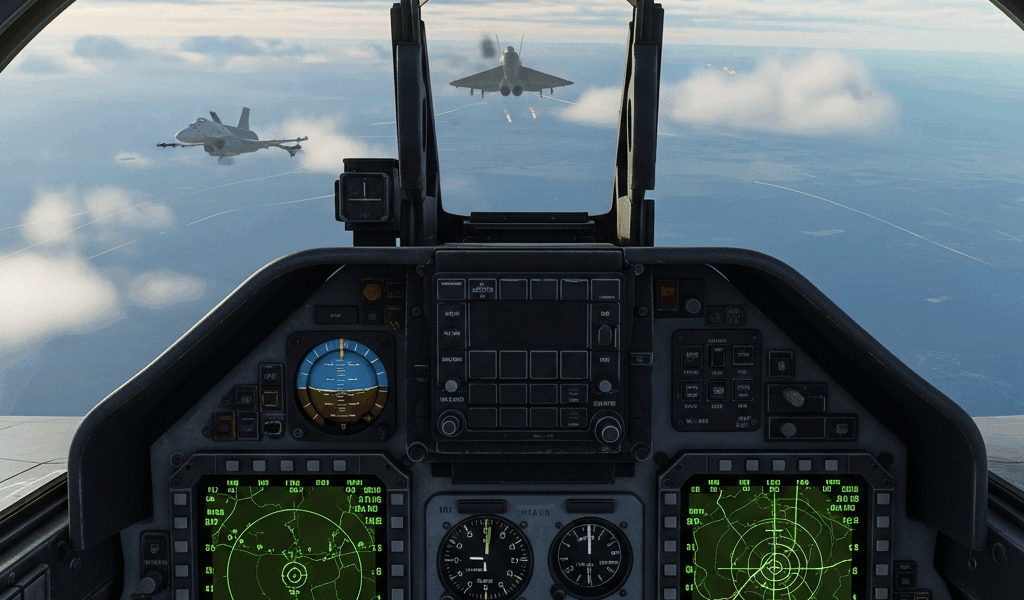
DCS World is free to download. The Su-25T Frogfoot is free to fly. But eventually you want to step into a full-fidelity cockpit where every switch clicks, every gauge moves, and the learning curve feels like a vertical wall. There are over 30 paid aircraft modules ranging from $30 to $80 each, and the forums are full of contradictory advice about which one to buy first. Here is the straightforward answer based on what you actually want to do in DCS — not which plane looks coolest in screenshots.
Start With the Free Su-25T
Before spending a dollar, fly the Su-25T for at least five hours. Not because it is a great aircraft — it is a simplified-fidelity ground attacker with a dated cockpit — but because it teaches you whether you enjoy the DCS experience at all. The UI, the keybinding system, the mission editor, the way the sim handles differently from MSFS or X-Plane — all of this needs to feel right before you invest in a full-fidelity module.
If five hours with the Su-25T feels tedious or frustrating in a way that is not fun, DCS might not be your sim. You just saved yourself $60. If those five hours leave you wanting more depth, more systems, more clickable switches — that is the signal to buy your first module.
Want Air-to-Air Combat? Get the F/A-18C Hornet
The F/A-18C is the default first module recommendation for a reason. It is a true multirole fighter — equally capable in air-to-air combat, ground attack, anti-ship strikes, and carrier operations. You will never run out of things to learn or do in it. When forum regulars say “just get the Hornet,” they are not being lazy — they are giving the statistically correct answer for most new pilots.
The startup procedure is simpler than older Cold War jets. The avionics use a modern HOTAS (hands on throttle and stick) philosophy, meaning most functions are accessible without hunting through cockpit panels. The HUD and multi-function displays are intuitive once you learn the menu structure. And the Hornet has the largest tutorial and guide ecosystem of any DCS module — YouTube alone has thousands of hours of Hornet-specific content.
On multiplayer servers, the Hornet is everywhere. You will always find wingmen, always find targets, and always find help when you are learning. That community density matters more than people realize when you are spending hours figuring out how to properly employ a JDAM for the first time.
Want Ground Attack? The A-10C II Warthog
If you watch combat footage and think “I want to put ordnance on target with surgical precision,” the A-10C II is your module. Its weapons systems are the deepest and most detailed in all of DCS. The CDU (central display unit) alone requires hours to learn properly. The targeting pod, the Maverick missile interface, the gun employment procedures — each one is a discipline unto itself.
Fair warning: the A-10C II has the steepest learning curve of any commonly recommended starter module. You will spend weeks before you feel competent enough to consistently find, identify, and destroy targets in a combat scenario. If that kind of deep systems mastery sounds appealing rather than exhausting, this is your plane. If it sounds like a second job, start with the Hornet and come back to the Hog later.
Want Something Simpler? The F-5E or Mirage 2000
The F-5E Tiger II is the closest thing DCS has to a stick-and-rudder fighter. Limited radar, limited weapons, no fancy targeting systems. It is you, a gun, two Sidewinders, and your eyeballs. If you want to learn aerial combat fundamentals — energy management, angles fighting, situational awareness — without drowning in systems complexity, the F-5E strips everything down to the essentials. It is also one of the less expensive modules and frequently goes on sale.
The Mirage 2000C sits between the F-5E’s simplicity and the Hornet’s complexity. It is a capable fighter with a solid radar and beyond-visual-range capability, but the cockpit is less cluttered than the Hornet and the systems are more focused. The Mirage also has excellent campaign content already available — more pre-built missions than many newer modules. If you want a French delta with character, the Mirage delivers.
The Flaming Cliffs 3 Shortcut
FC3 gives you seven aircraft — F-15C, A-10A, Su-27, Su-33, MiG-29A, MiG-29S, and Su-25 — at simplified fidelity. Simplified means the cockpits are not fully clickable, the systems are streamlined, and the startup is abbreviated. Think of it as DCS with training wheels.
At full price ($50), it is decent value. On sale ($15-20), it is a steal. FC3 lets you try multiple aircraft types — pure air superiority in the F-15C, close air support in the A-10A, Russian fighters with different flight models — without committing to mastering any single cockpit. The downside: once you experience a full-fidelity module, the simplified cockpits feel flat. Most pilots eventually migrate to full-fidelity aircraft and never go back.
What to Skip as a Beginner
Helicopters: The Ka-50, Mi-24, UH-1H, and AH-64D are all exceptional modules. They are also significantly harder to fly than any fixed-wing aircraft. Helicopter flight dynamics in DCS require rudder pedals (practically mandatory, not optional) and a level of hover precision that takes dozens of hours to develop. Get comfortable with fixed-wing first. Come back to rotary after you have mastered basic flight.
The F-14 Tomcat: It is an incredible module — possibly the best aircraft simulation ever made. It is also designed for a two-person crew (pilot and radar intercept officer), and flying it solo means Jester AI handles your back seat with mixed results. The systems are complex, the flight model is demanding (flat spins are real and deadly), and the old-school radar requires genuine skill to operate. Buy it second or third, not first.
WWII warbirds: The Spitfire, P-51, FW-190, and Bf-109 are beautifully modeled but cater to a specific interest. If you are not specifically drawn to WWII air combat, these modules will gather dust. They also fly very differently from jets — torque management, prop pitch, mixture control — which can confuse beginners who are simultaneously learning the DCS interface.
The bottom line: If someone holds a gun to your head and demands one module recommendation for a brand new DCS pilot, the answer is the F/A-18C Hornet. Not because it is the best aircraft in every category — it is not — but because it is good enough at everything to keep you engaged for hundreds of hours while you figure out what you actually love about DCS. Then you buy your second module based on real experience, not forum advice from strangers.


Stay in the loop
Get the latest ultimate flight simulators updates delivered to your inbox.