DCS F-16 vs F-15E Module — Which Jet Wins
Choosing between the DCS World F-16C and F-15E Strike Eagle feels like a decision that should be simple but never is. I’ve spent the better part of two years bouncing between these two modules, and I can tell you: they’re not interchangeable, and your first choice matters more than you’d think.
The question isn’t really which jet is better. It’s which one matches your brain, your available study time, and what you actually want to fly.
Avionics Complexity and Learning Curve
Let me start with the uncomfortable truth I should’ve opened with, honestly: the F-15E’s avionics are objectively more complex than the F-16’s, but not in the way you’d expect.
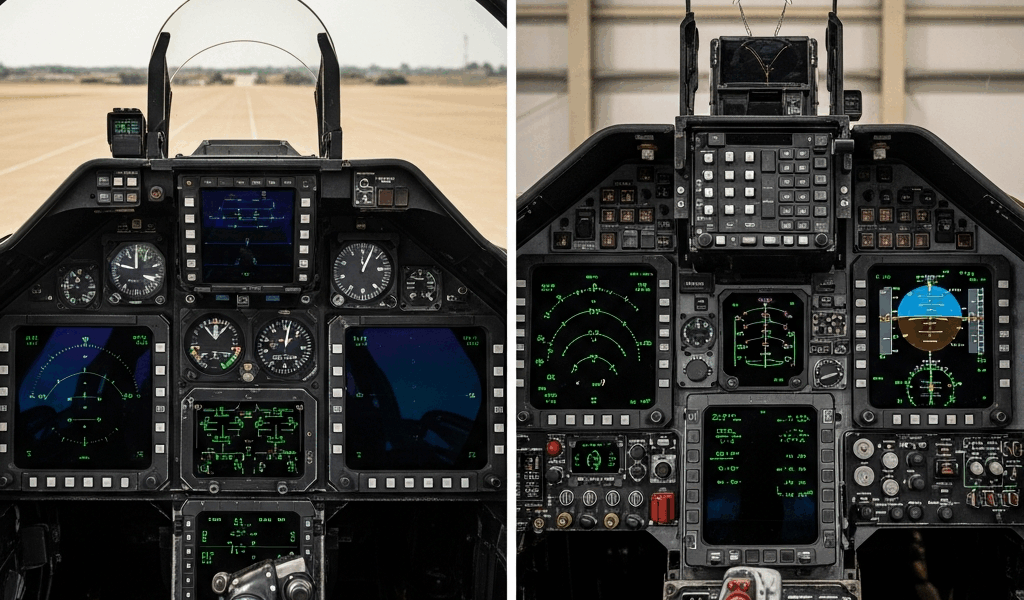
The F-16C runs a glass cockpit. Everything feeds through the Integrated Premonition Display System (IPDS) — your radar, your targeting pod, your digital map, your weapon-firing solutions. It’s unified. When you’re learning the F-16, you’re really learning one system with multiple displays showing different aspects of the same data. That’s conceptually elegant.
The F-15E? It’s a traditional two-seat layout (pilot in front, WSO in back) with redundant systems that don’t always talk to each other the way modern glass cockpits do. Your radar is separate from your targeting pod. Your electronic warfare receiver has its own logic. The WSO manages ground mapping while you manage air search. Probably should have opened with this section, honestly—because this division is what makes the F-15E a different animal entirely.
Here’s what this means in practice. In the F-16, I’m switching between pages on a single set of displays. Radar page, then weapon page, then systems page. The learning cliff is steep but narrow—once you understand how data flows on the Viper’s display architecture, you’re past 60% of the learning curve.
The F-15E? You’re learning two different pilot stations. Solo pilots in DCS can manage both, but the cognitive load is different. You’re scanning two instrument panels, managing two distinct systems philosophies, and coordinating between roles that are physically separated in the real aircraft. The community feedback on this is consistent: “The F-16 clicks faster. The F-15E clicks deeper.”
Time to basic proficiency:
- F-16C—30 to 40 hours of focused study to handle a basic strike package with some autonomy. Radar employment takes another 15 hours.
- F-15E—50 to 70 hours to feel competent at both pilot and WSO stations. Strike mission planning takes an additional 20 hours.
For specific tasks: programming waypoints on the F-16 means accessing the TPOD (targeting pod) menu, selecting a mark, storing coordinates. Three steps, familiar UI logic. On the F-15E, waypoint programming involves the inertial navigation system (INS) alignment procedure, manual coordinate entry into the weapon-aiming computer (WAC), and a pre-flight systems check that takes five minutes minimum. Not harder. Just more deliberate.
Radar mode switching is where the avionics philosophies diverge most clearly. The F-16’s ground mapping radar transitions between modes with a few button presses and instant visual feedback. The F-15E’s radar requires understanding beam tilt, range gating, and the relationship between your current altitude and the map resolution you’re getting back. You can’t just assume the radar is doing the right thing.
Weapon employment reveals the gap too. F-16 AMRAAM employment is systematic—lock, launch envelope, done. F-15E Sidewinder employment involves understanding the back-seat geometry, the visual search problem from a strike aircraft perspective, and energy state management that’s less forgiving. The F-16 is a fighter first. The F-15E is a striker that can fight.
Third-Party Support and Community Mods
The F-16C wins this category decisively, and it’s not close.
Livery pack count alone tells the story. The F-16 Viper ecosystem has roughly 400+ community-created liveries available through sources like DigitalCombatSimulator.com and specialized livery Discord communities. The F-15E community maintains roughly 180 liveries. But liveries are the marketing material—the real meat is deeper.
The F-16 has a sprawling third-party weapon modification scene. Groups like the Darkside virtual squadron maintain custom JSOW variants, unofficial Paveway IV implementations, and AGM-88 HARM database updates. The F-16 Viper enthusiasts Discord (4,200+ members as of my last check) is absurdly active. New mission frameworks, targeting pod texture improvements, and avionics database updates appear monthly.
The F-15E community is smaller. Core developers like the Strike Eagles community on the Hoggit Discord maintain solid documentation—their WSO systems guide is actually superior to any F-16 resource I’ve found. But the volume of third-party content is maybe 40% of what the Viper community produces. Fresh campaign frameworks appear every three months instead of monthly. Livery updates trail by about six months on average.
Why the gap? The F-16 was a module earlier in DCS’s modern fighter rollout, so it accumulated community momentum. The F-15E is newer (full release was 2023) and is still building its ecosystem. That said, the F-15E’s documentation quality is higher—you’ll find fewer “figure it out yourself” moments because the existing community tends to document exhaustively.
For retention, this matters. You buy a module, then you live in the third-party ecosystem—new campaigns, updated liveries, refined mission frameworks. The F-16 sustains engagement longer because the supply is constant. The F-15E rewards deeper engagement because study is rewarded with rare but high-quality resources.
Multiplayer and Server Ecosystem
Both aircraft are staples on dedicated servers. Blue Flag (the Hoggit community’s flagship multiplayer campaign) supports both equally. The Viper usually represents the 50-55% of fighter slots; F-15E makes up 30-35%. The remainder are older modules.
Server preferences break down by mission type, and this is where you see real strategy.
The F-16 dominates fighter sweep and air-to-air engagement servers because it’s responsive in that role and the learning curve doesn’t punish reflexes. Servers like NATO vs OPFOR (Caucasus map) see F-16 availability at about 60% for air superiority slots.
The F-15E owns strike-focused servers. The Growling Sidewinder server (Persian Gulf) and Enigma’s Edge campaign (also Persian Gulf) are F-15E strongholds not because pilots prefer it, but because the aircraft’s systems shine in pre-planned strike missions with WSO coordination. If you queue for a strike package, the F-15E player count jumps to 40-50% of available aircraft.
Practically: if you want consistent multiplayer availability, the F-16 is safer. If you want a niche where your expertise is actually valued, the F-15E is less crowded and more appreciated.
One hidden advantage for F-15E pilots—because the player base is tighter, you’ll actually get to know the people you fly with. The F-16 rooms can feel like rotating doors. The F-15E squadrons are more cohesive.
Weapon Employment and Mission Design
Both jets approach modern warfare completely differently—shaped by competing design philosophies from their respective eras.
The F-16C is a multi-role fighter—it does air-to-air adequately, ground attack capably, and both with single-pilot simplicity. In DCS, weapon employment is intuitive. Lock a target with the Viper’s radar, designate with the targeting pod, employ weapons. The systems are designed for rapid decision-making.
The F-15E is a dedicated strike aircraft with formidable self-defense. The WSO manages the targeting and navigation complexity while the pilot manages the strike execution and defensive flying. Weapon employment is deliberate—you don’t just “lock and launch.” You set up the target geometry, coordinate with the WSO, verify the solution, then execute. It’s slower by design because speed wasn’t the original requirement; lethality was.
Air-to-air in the F-16 is forgiving. Your radar gives you immediate feedback. Your targeting pod can slew to visual targets. The flight model is responsive. New pilots in F-16s can score air-to-air kills within 10-15 hours of study.
Air-to-air in the F-15E requires understanding rear-seat geometry and pre-plan coordination. You’re not dogfighting it; you’re employing standoff weapons from a position the WSO calculates. The F-15E will defend itself, but it’s defending itself, not hunting. There’s a real distinction.
Ground attack is where the F-15E justifies its existence. The Pave Strike targeting system, the weapons management computer, the two-seat architecture—all of it is built for systematic, accurate strike planning. A trained F-15E crew on a complex target set operates at a level the F-16 can match only through raw pilot skill. The systems do more of the work.
Mission design considerations: F-16 excels in dynamic, improvisational scenarios. F-15E dominates in planned, target-complex environments. Pick the module based on how you like to think about flying.
Our Verdict — Which to Buy First
Here’s the stance without equivocation.
If you’re new to DCS or coming from arcade flight sims, buy the F-16C first. The avionics learning curve is steep but focused. You’ll achieve competence faster. You’ll have access to more community resources and more multiplayer availability. The cognitive load is lower because the systems are unified. You’ll log meaningful flight hours sooner. 30-40 hours and you’re genuinely dangerous in multiplayer.
If you’re already proficient in complex modules—if you’ve flown the A-10C, if you understand two-seat workflows, if you like systematic mission planning—buy the F-15E. Yes, it costs 20% more in learning time (70 hours vs. 40 to proficiency). It costs zero more in actual dollars. The ROI is worth it because the module will hold your interest longer. The systems design is more satisfying once you’ve invested. The community is tighter and more collaborative. Strike missions in the F-15E are more rewarding than they are in the F-16 because the aircraft is designed for exactly that role.
Honest assessment: the F-16 is the smarter first buy for most pilots. Faster payoff, larger player base, shallower learning cliff. The F-15E is the better second buy for ambitious pilots. Richer systems, more specialized role, deeper satisfaction.
The hidden cost isn’t dollars. It’s weeks of study vs. weeks of payoff. The F-16 gets you flying faster. The F-15E gets you flying deeper. Both are excellent modules.
Choose based on your patience and your preferred mission type. Everything else follows from that.
For a wider first-purchase framework beyond this fighter comparison, see the best DCS modules for beginners, including Flaming Cliffs 2024 and the official trial process.


Stay in the loop
Get the latest ultimate flight simulators updates delivered to your inbox.